Reviewed by the PolishReady team
C1 Polish Reading Strategies: How to Handle Long, Abstract Texts
C1 reading passages are longer, denser, and more abstract than B2 — and skimming for keywords stops working. Here's how to actually read at C1 level under exam time pressure.
Key takeaways
- C1 reading passages are abstract and structurally complex — keyword-scanning strategies that work at B2 stop being reliable.
- Read for the text's overall structure and argument first, before diving into individual questions.
- Practice tolerating unfamiliar vocabulary by inferring meaning from context rather than stopping on every unknown word.
- Use a two-pass approach: read the full text once for meaning, then return to specific paragraphs to answer questions.
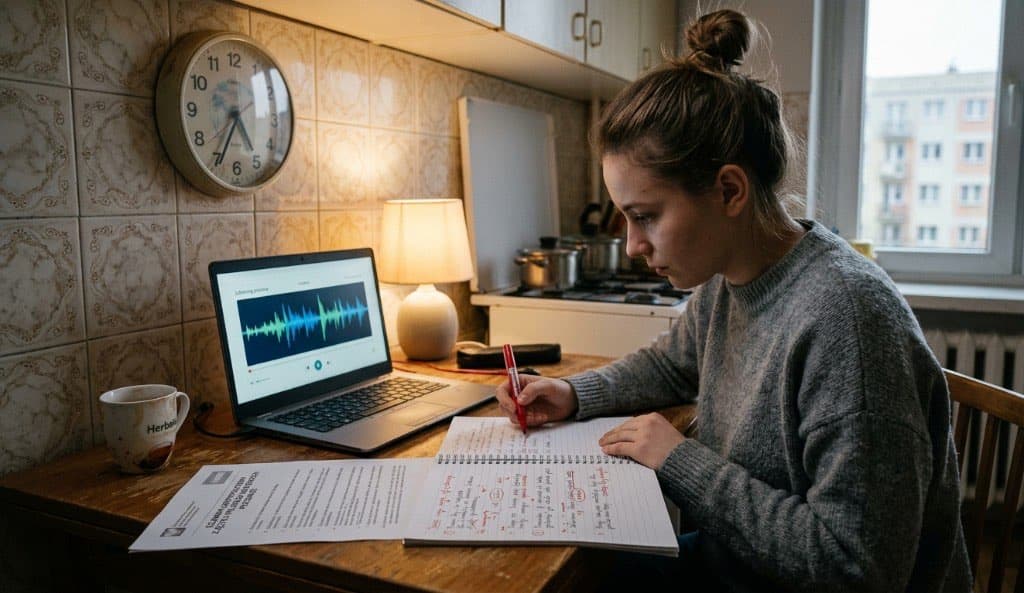
The jump in reading difficulty from B2 to C1 surprises a lot of candidates who assumed 'more of the same, but harder.' It isn't. B2 reading passages are usually concrete and single-topic; C1 passages are frequently abstract, argumentative, or drawn from specialized domains, and they expect you to track implied meaning and the author's stance, not just extract facts. The strategies that worked at B2 — scanning for keywords that match the question — genuinely stop being reliable at C1.
The first shift is reading for structure before reading for detail. Before answering any question, spend 30–60 seconds identifying the text's shape: is it presenting one argument, comparing two positions, describing a process, or narrating an event with a twist? At C1, questions frequently target how the argument is built, not just what is stated, so understanding structure first makes every subsequent answer faster to locate and verify.
The second shift is tolerating uncertainty on individual words. C1 texts will contain vocabulary you don't know — that is expected and does not automatically block comprehension. Practice inferring likely meaning from context and word formation (Polish prefixes and suffixes are highly regular and often signal meaning) rather than stopping to mentally 'solve' every unfamiliar word, which burns time you don't have and disrupts your grasp of the sentence's overall point.
The third shift is distinguishing stated fact from implied opinion. C1 comprehension questions frequently ask what the author implies, believes, or would likely agree with — not just what they explicitly wrote. Practice this deliberately: after reading a paragraph, ask yourself 'what does the author actually think about this, even though they didn't say it directly?' This skill transfers directly to the exam's most commonly missed question type at this level.
On timing, C1 reading sections reward a two-pass approach: read the full text once for overall meaning without stopping on individual questions, then go through the questions and return to specific paragraphs to verify or locate detail. Reading question-by-question from the start, re-reading the whole passage for each question, is the single biggest time-waster candidates report — and it gets worse, not better, as texts get longer at C1.
Build these skills with full-length timed passages rather than short exercises, since C1 reading difficulty is partly about sustained concentration across a long, dense text, not just individual sentence comprehension. PolishReady's C1 reading practice is built around exactly this exam format — use it regularly rather than occasionally, since this skill degrades faster than vocabulary if you stop practicing it.