Reviewed by the PolishReady team
Polish B1 Speaking Exam: 15-Minute Tasks & Prep Tips
What happens in the 15-minute B1 speaking exam: pictures, situations, opinions — plus how to practice fluency, phrases, and confidence before test day.
Key takeaways
- The B1 speaking exam lasts about 15 minutes with warm-up, picture, and role-play tasks.
- Describe pictures with a fixed flow: scene, details, speculation, then personal opinion.
- Examiners score completion, fluency, vocabulary range, and grammar—not perfection.
- Speaking aloud, recording yourself, and thinking in Polish give the biggest gains.
- Reuse one picture structure and one shop-complaint script until both feel automatic.
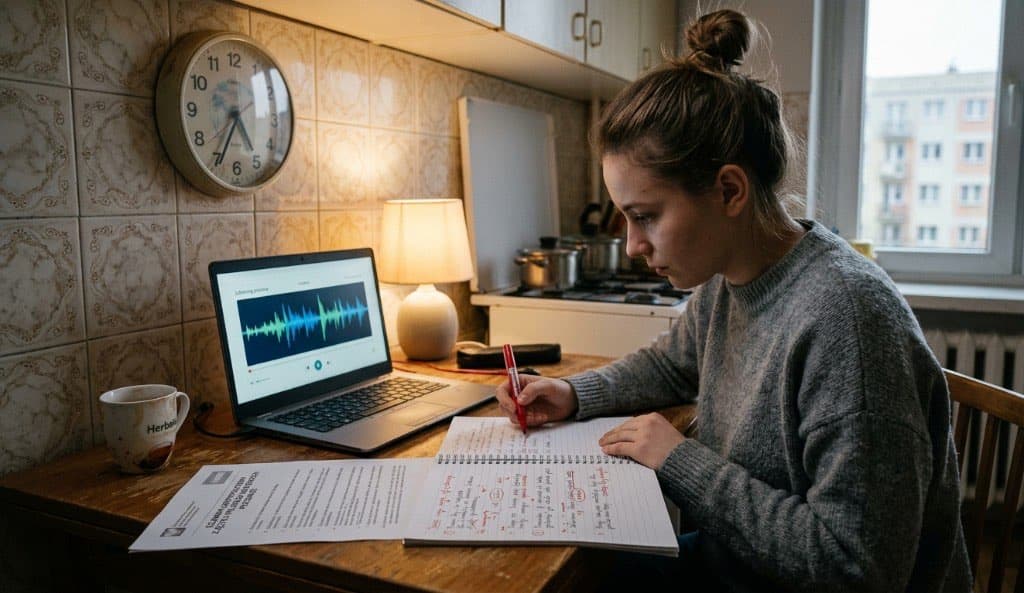
The speaking section of the B1 Polish exam lasts approximately 15 minutes and is conducted face-to-face with one or two examiners. It is the section that causes the most anxiety — but it is also the section where preparation gives you the biggest return on investment. Unlike grammar or reading, speaking can be improved dramatically in just a few weeks of targeted practice.
The speaking exam typically has three parts. First, a warm-up conversation where the examiner asks you about yourself — your name, where you live, what you do, why you are learning Polish. This part is not heavily scored but sets the tone. Second, a picture description task where you receive a photograph showing an everyday scene and must describe what you see, what might be happening, and express an opinion about it. Third, a situational task where you must role-play a scenario — booking a hotel, making a complaint in a shop, discussing plans with a friend.
For picture descriptions, develop a reliable structure you can apply to any image. Start with the general scene: 'Na zdjęciu widzę...' (In the picture I see...). Then describe specific details: people, objects, setting. Then speculate about what is happening: 'Myślę, że...' (I think that...), 'Wygląda na to, że...' (It looks like...). Finally, express a personal opinion: 'Moim zdaniem...' (In my opinion...). Practicing this structure with random photos from your phone takes 5 minutes and builds enormous fluency.
For situational tasks, prepare set phrases for common scenarios. Complaints: 'Chciałbym/Chciałabym złożyć reklamację' (I would like to make a complaint). Requests: 'Czy mógłby Pan/mogłaby Pani...' (Could you...). Expressing preferences: 'Wolę... niż...' (I prefer... to...). Agreeing and disagreeing: 'Zgadzam się' (I agree), 'Nie jestem pewien/pewna' (I am not sure). Having 15–20 such phrases ready means you can enter any scenario with a toolkit of responses.
The examiner evaluates four dimensions: task completion (did you address what was asked), fluency (can you speak without long pauses), vocabulary range (do you use varied words or repeat the same ones), and grammatical accuracy (are your case endings and verb forms correct). Importantly, perfection is not expected at B1. You can make grammatical mistakes and still pass. What matters is whether the examiner can understand you and whether you can sustain a conversation without constant breakdowns.
The single best preparation method is speaking out loud — alone or with a partner. Record yourself answering practice questions and listen back. You will notice patterns: maybe you always pause before past tense verbs, or you default to 'bardzo' (very) instead of using more specific adverbs. Fix one pattern per week. Also, practice thinking in Polish rather than translating from your native language. Candidates who construct sentences directly in Polish speak more fluently and make fewer errors than those who mentally translate each sentence before saying it.
Picture task, 60 seconds. Use the same four beats every time. Scene: «Na zdjęciu widzę kolejkę w urzędzie. Jest zima, ludzie mają kurtki.» Detail: «Kobieta przy okienku pokazuje dokumenty. Mężczyzna za nią patrzy na telefon.» Speculation: «Wygląda na to, że czekają na numerki albo na pieczątkę.» Opinion: «Moim zdaniem takie kolejki są męczące, ale trzeba zachować spokój.» Practise this on five random phone photos this week.
Role-play: complaint in a shop. Greeting: «Dzień dobry, chciałabym złożyć reklamację.» Problem: «Kupiłam ten czajnik wczoraj, ale nie działa.» Request: «Proszę o wymianę albo zwrot pieniędzy.» Close: «Czy mogę dostać potwierdzenie na piśmie?» If the examiner interrupts, answer the new question, then return to the request. Missing the request is the most common way to fail task completion.